After a long period during which this blog has been in abeyance, I've decided to bring it back into play by using it as a place for collecting quotes relating to the spiritual life. They won't be as lengthy as the earlier set; just short and to the point.
So here's today's entry.
We declare how we value God as much by our actions, by the way we treat other people, by the manner in which we do our work, as by anything we say. If my actions are wrong or wrongly motivated prayer cannot make them right. If however, despite my failures and inconsistencies, I do on the whole want to put God above all things then prayer will help to purify my motives and clarify my judgement.
Christopher Bryant, from his book The River Within: the search for God in the depth
published Darton, Longman and Todd, 1979
Pursue peace with everyone, and the holiness without which no one will see the Lord.
- Hebrews 12:14
Saturday, October 31, 2009


Monday, September 11, 2006
Fresh Bread and Other Gifts of Spiritual Nourishment

The Call to Discipleship," from "Fresh Bread and Other Gifts of Spiritual Nourishment", by Joyce Rupp.
On one of my retreat days last summer, I stooped to pick up a fallen cottonwood leaf. My heart had been deep in reflection on discipleship and the leaf suddenly symbolised all that I had been praying. Very neatly eaten out of the leaf was a hole, thumbprint size. The tiny chomp marks of a caterpillar or some avaricious insect could be easily seen. My worn spirit looked long at that leaf. I said to myself, "I feel like that: eaten up by my work; the events of my calendar have taken a large space in me."
I have since asked myself many questions about ministry and the feeling that I sometimes get of being "eaten up." I have gone to God in prayer and questioned how much of myself I can afford to give and how much I need to keep. No easy answers have come but gradually I have learned some lessons about the "holes" I sometimes feel in my spirit.
Morton Kelsey so wisely states in Reaching for the Real, "To one person hard work is only pain; to another it is the opportunity to create something of value." To this I'd add, "To some, hard work is just a chomped out hole in one's spirit; to another, it is an opportunity to create something of value for the Kingdom of God. The secret to living with those empty spaces is to have the attitude of a disciple of Jesus.
I have never gotten used to the truth of discipleship: that to belong to Jesus means more than just a good feeling of being cherished and loved. I still struggle with the fact that there are conditions for discipleship and that "following" means some hard demands and some constant conversion:
Then Jesus said to his disciples, "If anyone wants to be a follower of mine, let him renounce himself and take up his cross and follow me. For anyone who wants to save his life will lose it; but anyone who loses his life for my sake will find it. What, then, will a man gain if he wins the whole world and ruins his life? Or what has a man to offer in exchange for his life?" (Mt 16: 24-26)
Too often I wish for a call free from obstacles, hurt, pain, disturbance, anxiety.
To follow Jesus in discipleship means that sometimes I will be rejected and misunderstood; I may not see results in ministry and I will need to give when nothing seems to be returned. "To follow" is to live with mystery and to walk in faith, knowing we are deeply loved. Even though discipleship is not always easy and even though sometimes we feel like there's a part of us that been eaten out or chewed on, we can still live with a heart of peace and deep joy. The secret is that attitude which Kelsey spoke of: We know we are creating something of value because our hearts are set on the one who invites us to follow.
Thursday, September 07, 2006
The Wounded Healer
 "The Wounded Healer." By Henri Nouwen: from Chapter 4 "Ministry by a lonely minister."
We live in a society in which loneliness has become one of the most painful human wounds. The growing competition and rivalry which pervade our lives from birth have created in us an acute awareness of our isolation. This awareness has in turn left man with a heightened anxiety and an intense search for the experience of unity and community. It has also led people to ask anew how love, friendship, brotherhood and sisterhood can free them from isolation and offer them a sense of intimacy and belonging. All around us we see the many ways by which people of the western world are trying to escape this loneliness. Psychotherapy, the many institutes which offer group experiences with verbal and nonverbal communication techniques, summer courses and conferences supported by scholars, trainers and "huggers" where people can share common problems, and the many experiments which seek to create intimate liturgies where peace is not only announced but also felt - these increasingly popular phenomena are all signs of a painful attempt to break through the immobilizing wall of loneliness.
But the more I think about loneliness, the more I think that the wound of loneliness is like the Grand Canyon - a deep incision in the surface of our existence which has become an inexhaustible source of beauty and self-understanding.
Therefore I would like to voice loudly and clearly what might seem unpopular and maybe even disturbing: The Christian way of life does not take away our loneliness; it protects and cherishes it as a precious gift. Sometimes it seems as if we do everything possible to avoid the painful confrontation with our basic human loneliness, and allow ourselves to be trapped by false gods promising immediate satisfaction and quick relief. But perhaps the painful awareness of loneliness is an invitation to transcend our limitations and look beyond the boundaries of our existence. The awareness of loneliness might be a gift we must protect and guard, because our loneliness reveals to us an inner emptiness that can be destructive when misunderstood, but filled with promise for him who can tolerate its sweet pain.
When we are impatient, when we want to give up our loneliness and try to overcome the separation and incompleteness that we feel, too soon, we easily relate to our human world with devastating expectations. We ignore what we already know with a deep-seated, intuitive knowledge - that no love or friendship, no intimate embrace or tender kiss, no community, commune or collective, no man or woman, will ever be able to satisfy our desire to be released from our lonely condition. This truth is so disconcerting and so painful that we are prone to play games with our fantasies than to face the truth of our existence. Thus we keep hoping that one day we will find the man who really understands our experiences, the woman who will bring peace to our restless life, the job where we can fulfill our potentials, the book which will explain everything, and the place where we will can feel at home. Such false hope leads us to make exhausting demands and prepares us for bitterness and dangerous hostility when we start discovering that nobody, and nothing can live up to our absolutistic expectations.
Beginning Again
From Chapter 4 "Beginning again with church" in "Beginning Again" by John Pritchard
Our expectations of the church should be high but realistic. Every church is a gathering of the walking wounded, some doing better than others but all of us damaged in one way or another. This is what makes churches potentially such places of healing. The church is a laboratory of the human, the place where we find out and experiment with the glorious task of becoming fully human and alive - ransomed, healed, restored and forgiven. But there will be disappointments along the way and we must not throw out the baby of faith with the dirty bath water of the church.
It may help to think of a room where young children have been playing all day. When we go in after they have gone to their tea the room looks like a disaster area. Toys and games lie everywhere, scattered around chaotically. What we may be conscious of is simply a mess. There is no life in these discarded objects lying knee-deep across the floor. However, when the children come back after tea and begin playing again, the whole situation changes. Life returns. The chaos becomes meaningful; the mess is actually an area of purpose and pleasure for children and their parents. Similarly, the church, when viewed by an outsider, may appear a mess. This is the way it is sometimes portrayed in the media. All that appears is muddle and confusion - lifeless objects covering the floor. However, when you see in the midst of the mess the presence of Christ, it all begins to make sense. This is the area of divine play, of the rich and colourful life of God, poured out for us in reckless love. In response to that love we play the best we can, and try to keep hitting each other to a minimum! But what was formerly unintelligible, now becomes marvellously alive. Our expectations of the church therefore have to be high, but realistic enough to recognize that it often appears to be a bit of a mixed bag, both to us and to others.
Expectancy, on the other hand, can never be high enough. When we come to church to worship, we are coming to meet with God. Worship is the technicolour film of our faith. It is offering all of ourselves to all God has revealed himself to be, and the outcome should be change. The result of truly encountering the terror and beauty of God is not conformity but transformation. We are broken open to the invasion of the Spirit, to the mystery of each other, and to the wounds of the world. When we come to worship we don't come to twiddle our thumbs. Expectancy is fully justified because it is directed towards God's activity and not ours.
Tuesday, August 29, 2006
How to Lead Evensong
 From chapter 6 of How to Lead Evensong by Gilly Myers, published by Grove Books 2005.
If there is no one to preach, there are still things that can be done during the ‘sermon’ slot. Here are a few simple examples:
Some bible commentaries are very accessible to ordinary people and are far from the academic tomes, full of Greek words and long sentences that clergy had to read at theological college! Having a storytelling style, they would work well if they were read out loud in a reflective manner. Bishop Tom Wright’s series Paul for Everyone and William Barclay’s Daily Study Bible are examples of this.
Ask a local minister who is preaching on the same Bible readings that day if their sermon could be delivered in your church too. Then find someone who would be able and willing to read it well.
There are books of sermons and homilies available, but their quality is variable. Check well in advance that they are suitable.
There are some websites that provide ready-made sermons, but be careful – they might be dreadful!
If you, or another member of the congregation, are used to leading a Bible study group, and the congregation would cope with this approach, you could consider putting together some questions to stimulate a short discussion about one of the readings.
What can we do if we are absolutely stuck?
It may be that omitting the sermon is unavoidable. If you have been asked to lead the service, and not to preach, then it is not your responsibility to produce a sermon. If this is a long-term solution, then there needs to be some discussion in the church as to how the congregation is going to crack open the Scriptures on a regular basis.
Monday, August 28, 2006
Paradox in the Gospel?
From chapter 7 of Paradox in the Gospel? by Jim Currin, published Grove Books 2006
One survey respondent observed: ‘Paradox is sadly lacking from most evangelism which seems to be the way of simple certainty, a fill-in-the-dots type of god offered by [a] formula sales team!’ Another agreed: ‘Absolutes have little place in Anglicanism; the black and white approach leaves too many gapss in thinking and in Christian response to all sorts of issues (virgin birth, homosexuality etc)’, to which another added, ‘Paradox is like the complexity of a colour photograph as opposed to the black and white simplicity of certainty.’
This last respondent, an experienced photographer, went on: ‘The Pharisees saw things in black and white while Jesus saw things in colour…note, colour includes black and white in [the] same way Jesus came to fulfil the law.’
Richard Holloway has observed the ‘Black and white issues’ are ‘more complicated than headlines’ while Jolley from research in the journal Anvil, quotes two out of fifteen experts on ‘Faith and Work’ who felt that ‘teaching which presented a prevailing "black and white" assumption about ethical mattes was likely to divide the faith and work of people who have to live with "gray" ethical compromises at work.’
Cyprian Smith does not comment specifically about ‘black and white’ theology. He is clear though that the gospel is ‘both/and’ and not ‘either/or.’ Further is it not gray but very ‘colourful,’ as Eckhart showed before him.
Thursday, August 24, 2006
Her Heart Can See
 From chapter 5 of Her Heart Can See: the Life and Hymns of Fanny J Crosby, by Edith Blumhofer, published by Eerdmans 2005.
Measured in sales, [Lowell] Mason’s 1841 Carmina Sacra (which the New York Times reported had enjoyed ‘a larger sale than any other music book ever published’) was his most successful single endeavour, but he kept producing new collections. ‘Every well organised choir, if kept up with interest, must have a constant succession of new music. Without this there will be no advancement….the progress of things is ever onward,’ Mason drilled into his following. Mason both stimulated and responded to the incessant clamour for something new: it nicely blended conviction and financial gain. Before he left for Europe in 1851, Mason was listed among Boston’s 2,000 wealthiest men, with a net worth in 2003 dollars of more than $2.45 million.
Mason’s affluence came at the price of incessant work. Admirers marvelled at the self-discipline that made his output possible. A newspaper reported that during his Boston years, Mason edited music and text during every meal and devoted mornings and afternoons to teaching, lecturing, and other business. After his evening meal he gave lessons or worked with his choir. His days seldom ended before midnight, and work often occupied him until 2 am. ‘It is said,’ one observer quipped when Mason was at the height of his fame, ‘that for twenty years he was never known to spend even half a day in mere amusement…his work was his recreation.’
In the heady days of the early republic, Northeasterners of Mason’s stamp dared to believe they could mold an American culture. Noah Webster urged an American language, benevolent societies envisioned a moral social order, Mason’s Boston cohorts supplied an American literature, Horace Mann imagined an educated public, and Mason himself made the case for the ennobling national benefits of music. While later critics sometimes grumbled about the ‘simplistic ditties’ and ‘easily digestible arrangements of themes from the classics’ that Mason permitted to ‘vitiate the tastes of generations,’ his contemporaries hailed him widely as one who offered both the plan and the tools to give the enjoyment and practice of music to ordinary Americans.
Mason acted on his convictions about the importance and promise of music in congregations and schools in many ways, none more important than the training he provided a privileged coterie that might be described as his proteges and partners-in-music. Two of these had prominent roles in Fanny Crosby’s life. One, George Frederick Root, found in Mason’s Boston circle the building blocks for a distinguished career. In time he brought vocal music education to the New York Institution for the Blind. The other, William Bradbury – composer, publisher, teacher, editor – became Crosby’s publisher, booster and friend. Mason molded Root and Bradbury. They, in turn, made Crosby a marketable commodity and so shaped the second half of her life.
Wednesday, August 23, 2006
The Little Book of Biblical Justice
 From chapter 3 of The Little Book of Biblical Justice – a fresh approach to the Bible’s teaching on justice, by Chris Marshall. Published by Good Books 2005
God’s partiality for the poor, we have suggested, is because of their greater vulnerability to unjust victimization. But the poor are not automatically virtuous. They are not always innocent of wrongdoing themselves. Where accusations are brought against them in court, biblical law requires the judicial system to treat all parties impartially.
"You shall not render an unjust judgement; you shall not be partial to the poor or defer to the great; with justice you shall judge your neighbour." [Leviticus 19:15]
"You shall not follow a majority in wrongdoing; when you bear witness in a lawsuit, you shall not side with the majority so as to pervert justice; nor shall you be partial to the poor in a lawsuit." [Exodus 23:2-3]
But impartiality is essential only for establishing guilt or culpability. Once that has been decided, the fundamental goal of the biblical justice is to restore what has been damaged by the offending. Restoration is required at several levels – restoration of the victim to wholeness, restoration of the offender to a right standing in the community, and restoration of the wider society to peace and freedom from fear, sin and pollution.
Punishments are often prescribed for particular offenses in biblical legislation. But punishment is a means to an end, not an end in itself. Contrary to what many people think today, punishment as such is not what satisfies the demands of justice. Justice is satisfied by repentance, restoration and renewal. Punishment serves as a mechanism for helping to promote such restoration.
Tuesday, August 22, 2006
A Time to Gather
The Trinity Sunday Meditation, from A Time to Gather – Christian meditations for the year, by Andrew Butcher. Self-published 2005.
‘Some of the worst people I know are Christians,’ my friend said to me. And I agreed: some of the worst people I know are Christians as well. Certainly some of the most invective correspondence I’ve ever received has come from Christians, and anyone who has been involved in churches for long enough knows that church politics beats even university politics, which is saying something.
But I added something to my response to my friend: some of the best people I know are Christians as well. Some of the kindest, most humble people I’ve met are Christians. I’ve gone away from conversations with these people and felt ‘edified,’ to use the biblical term.
It’s a fact of human nature that we like people like us. We like people who think the same way as us, talk the same way as us, and believe the same things as us. But the church – or, more broadly, the community of faith in which we confess – should be made up of those that are different from as well.
Psychology has shown that we tend to believe that the majority of people think the same way as we do, when actually that may not be the case. The thing is our faith – our Christianity – is most comfortable when it’s among like-minded people who agree with everything we say and don’t rock the boat too much. But that’s not what it’s about. Our faith connects with our life when the rubber hits the road: in times of conflict, in times of questions, in times of difference.
I’m reminded of John Hawkesby’s phrase that we’ve taken the cross and exchanged it with a butter-knife. The Cross is an offense to our sensibilities and should shake us from our complacency, much like the vents of the Gospel of Acs shook the disciples from their familiar territory. As they discovered, there are no persona non grata where God is concerned. God calls us to live our faith with, and amongst, everyone – whether we’d like to or not.
‘Some of the worst people I know are Christians,’ my friend said to me. And I agreed: some of the worst people I know are Christians as well. Certainly some of the most invective correspondence I’ve ever received has come from Christians, and anyone who has
 been involved in churches for long enough knows that church politics beats even university politics, which is saying something.
But I added something to my response to my friend: some of the best people I know are Christians as well. Some of the kindest, most humble people I’ve met are Christians. I’ve gone away from conversations with these people and felt ‘edified,’ to use the biblical term.
It’s a fact of human nature that we like people like us. We like people who think the same way as us, talk the same way as us, and believe the same things as us. But the church – or, more broadly, the community of faith in which we confess – should be made up of those that are different from as well.
Psychology has shown that we tend to believe that the majority of people think the same way as we do, when actually that may not be the case. The thing is our faith – our Christianity – is most comfortable when it’s among like-minded people who agree with everything we say and don’t rock the boat too much. But that’s not what it’s about. Our faith connects with our life when the rubber hits the road: in times of conflict, in times of questions, in times of difference.
I’m reminded of John Hawkesby’s phrase that we’ve taken the cross and exchanged it with a butter-knife. The Cross is an offense to our sensibilities and should shake us from our complacency, much like the vents of the Gospel of Acs shook the disciples from their familiar territory. As they discovered, there are no persona non grata where God is concerned. God calls us to live our faith with, and amongst, everyone – whether we’d like to or not.
Monday, August 21, 2006
The Great Jesus Debates
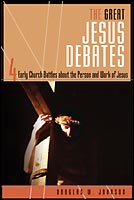
From chapter 6 of The Great Jesus Debates – 4 Early Church battles about the Person and work of Jesus, by Douglas Johnson. Published by Concordia 2005
Probably the most common and ‘popular’ accusation against the Early Church fathers is that they obscure the Gospel of Jesus by subjecting it to needless and even distorting intellectual formulas and complex creedal decrees. Those who make this accusation are typically, but not necessarily, individuals who are adverse to any and all theological statements of belief. They probably align themselves with a congregation, denomination, or even a non-Christian religion because they feel welcome, the music is good, the morality seems right, there are good programs, or the sermons are uplifting. Perhaps these individuals are even attracted to a group because its people rang their doorbell and invited them to church. For them, belief in some higher power and the dedication to living a good life are enough. Theological niceties are resented and should be avoided. Other, more existentially important matters, are at hand. In fact, much of the contemporary appeal of some forms of Judaism and Islam arises because they have a simple belief in one God, accompanied by an appropriately simple moral code. Thus some churches are tempted to believe that the less theology in which we indulge, the better we can get along with our neighbours in this multicultural world.
Rest assured, however, that the response of the Church fathers to this attitude would be fairly unanimous. On one hand, they would agree that idle speculation into the nature of God and his interaction with the human family can and does lead to disaster. In fact, much of the work of the early Christian thinkers and the decrees of the Early Church councils was accomplished precisely to limit such speculation. On the other hand, the early Church fathers would just as strongly insist that beliefs do matter, that our mind is an important, perhaps central, part of our being and what we believe has a profound influence on our relationships with God and our fellow human beings. Christianity is more than feelings and good works. What we think is important too.
Further, the people who decry theological statements really do have a theology in their minds, no matter how unreflective it may be. Therefore, we should think through our doctrines and straighten them out from the outset or they can lead us to precisely those entangling speculations we mean to avoid. A refusal to consider a clear statement of one’s own beliefs can leave a person open to all kinds of strange and harmful ideas and practices in the future.
For the Early Church fathers, ‘getting it right’ involved the grace of God in Jesus Christ. This was their touchstone. Whatever threatened to deny grace was rejected. This was the major source of those theological formulations that to some seem so burdensome today.
Wednesday, August 16, 2006
Shrewd Sanctity
From chapter 10 of Shrewd Sanctity – the story of Kathleen Hall 1896-1970, missionary nurse in China, by Rae McGregor, published by Polygraphia 2006
After giving instructions to her [Chinese] nurses about what should be done at the clinic while she was away she began the long walk to the railway line where she could catch a train to Beijing. It was a relief that there were no obstructions [from the Japanese] and she arrived in Beijing full of enthusiasm for the future of the mission at Songjiazhuang.
She was in for a shock.
The Japanese had made a formal complaint about her to the British Embassy and were demanding that she be sent out of China. After all her efforts to keep her work quiet a well-meaning Chinese journalist had heard about her activities and written a glowing article about her in a Chinese newspaper. Of course the Japanese intelligence read all the newspapers and immediately became suspicious of her. She was ordered out.
There was a message for her from Mr Britland saying she was to go immediately to Hong Kong and get in touch with Bishop Hall. Her life was in danger and on hearing of her arrival in Beijing the mission had made out a travel pass so she could leave immediately.
She didn’t want to go and, during the night, she considered over and over again ways in which she could slip out into the Western Hills and return to the JinChaJi area. She knew the terrain, all the paths that others didn’t know. It would be easy for her to make her way out of Beijing and get back into the village in the hills. But as the night wore on she realised that now she was a big danger to others. The Japanese would be watching her. Anyone she contacted would immediately be suspect and in mortal danger. Even if she did get through safely, she wouldn’t be able to take any supplies with her and it would only be a matter of time before she was hunted down.
After her sleepless night she dressed early, aware that there was nothing she could do but go. Through her secret contacts in Beijing she sent messages back to her nurses at Songjiazhuang. It was a miserable thought that she wouldn’t be able to continue her work, but worse that she couldn’t say goodbye.
After giving instructions to her [Chinese] nurses about what should be done at the clinic while she was away she began the long walk to the railway line where she could catch a train to Beijing. It was a relief that there were no obstructions [from the Japanese] and she arrived in Beijing full of enthusiasm for the future of the mission at Songjiazhuang.

She was in for a shock.
The Japanese had made a formal complaint about her to the British Embassy and were demanding that she be sent out of China. After all her efforts to keep her work quiet a well-meaning Chinese journalist had heard about her activities and written a glowing article about her in a Chinese newspaper. Of course the Japanese intelligence read all the newspapers and immediately became suspicious of her. She was ordered out.
There was a message for her from Mr Britland saying she was to go immediately to Hong Kong and get in touch with Bishop Hall. Her life was in danger and on hearing of her arrival in Beijing the mission had made out a travel pass so she could leave immediately.
She didn’t want to go and, during the night, she considered over and over again ways in which she could slip
 out into the Western Hills and return to the JinChaJi area. She knew the terrain, all the paths that others didn’t know. It would be easy for her to make her way out of Beijing and get back into the village in the hills. But as the night wore on she realised that now she was a big danger to others. The Japanese would be watching her. Anyone she contacted would immediately be suspect and in mortal danger. Even if she did get through safely, she wouldn’t be able to take any supplies with her and it would only be a matter of time before she was hunted down.
After her sleepless night she dressed early, aware that there was nothing she could do but go. Through her secret contacts in Beijing she sent messages back to her nurses at Songjiazhuang. It was a miserable thought that she wouldn’t be able to continue her work, but worse that she couldn’t say goodbye.
Tuesday, August 15, 2006
Prayer – does it make any difference?
From chapter 12 of Prayer – does it make any difference? by Philip Yancey, published by Hodder & Stoughton 2006.
Daniel Yankelovich, an astute observer of social trends, points to a cultural shift that occurred in the West in the 1970s. Before then, society valued self-denial or ‘deferred gratification.’ Spouses sacrificed, even if it meant holding two jobs and accepting transfers to other cities, in pursuit of long-term goals. Parents trapped in an unsatisfying marriage stayed together for the sake of the children. In the 1970s the rules changed: the self-denial ethic morphed into the self-fulfilment ethic. We listen to our emotional needs and want them fulfilled now, without sacrifice, without waiting. We buy whatever we want on credit and jettison anything that proves complicated or irksome (like a troublesome marriage, for instance).
Under the new rules prayer loses out. It requires discipline, involves persevering through periods of darkness and dryness, and its results are difficult to measure. Rarely does it satisfy emotional cravings right away.
Indeed, the New Testament presents prayer as a weapon in a prolonged struggle. Jesus’ parable on prayer show a widow pestering a judge and a man pounding on his neighbour’s door. After painting a picture of the Christian as a soldier fitted out with the ‘full armour of God,’ Paul gives four direct commands to pray. Elsewhere, Paul urges his protégé Timothy to endure hardship like a soldier, to toil like a farmer, to compete like an athlete.
I have neither farmed nor served in the military but for thirty years I have been a runner, often entering charity races. I remember well how it all started. I met a young man named Peter Jenkins at a writers’ conference as he was working on the book A Walk Across America, which later became a national bestseller. As he recounted some of his adventures on a long walk across the country, he said, ‘I get tired of these reporters flying down from New York, renting a car, then driving out to meet me. They hit the electric window button of their air-conditioned car, lean out, and ask, ‘So, Peter, what’s it like to walk across America?’ I’d like a reporter to walk with me for a while!’ Without thinking, I volunteered. [Now,] my body has become so accustomed to [exercise] that, if I have to skip a few days because of injury or illness, I feel edgy and restless.
As with physical exercise, much of the benefit of prayer comes as a result of consistency, the simple act of showing up. The writer Nancy Mairs says she attends church in the same spirit in which a writer goes to her desk every morning, so that if an idea comes along she’ll be there to receive it. I approach prayer the same way. Many days I would be hard-pressed to describe a direct benefit. I keep on, though whether it feels as if I am profiting or not. I show up in the hope of getting to know God better, and perhaps hearing from God in ways accessible only through quiet and solitude.
Friday, August 11, 2006
Growing Great Boys
 From chapter 4 of Growing Great Boys –100s of practical strategies for bringing out the best in your son, by Ian Grant. Published by Random House 2006
I suggest to mothers that your boys receive the clear message that you are a leader who is not easily threatened. So if your son calls you a silly old bag (or something worse), instead of trying to get back at him through guilt by telling him about all the things you’ve ever done for him, just walk away. Don’t try to engage or yell back; just withdraw your availability. Several hours later, when he comes to you asking, ‘Hey Mum will you take me down to the shops, I need to get some stuff for school,’ respond by saying something like this, ‘I’m sorry….mothers do things like that – but ‘old bags’ don’t.’ Don’t, under any circumstances, take him. Always require some level of restitution and restoration for what he has done or said. Otherwise he will learn to use ‘phoney’ sorrys, which carry no level of regret or responsibility for the action.
A single mother told me that her eleven-year-old boy had called her a ‘b…b…’. She had attended a seminar and remembered the above illustration. So she responded with, ‘You will not use those words to me,’ and walked away. She thought about how she could withdraw her services from her son.
The next morning she didn’t provide his usual wake-up call, leaving him to take responsibility for his own morning routine. He got up in a panic, after sleeping in, as he had the responsibility of working the overhead projector at his school assembly that morning. He begged his mother to drive him to school, at which point she said, ‘Mothers do things like that, but I’m sorry b….b…s’ don’t.’
He begged, pleaded…and even promised to do the dishes for a year! It was such a good offer, she said that she nearly took it up – but instead she remained firm. He had to walk to school. However, being a smart woman, she rang the deputy principal and told him what had happened. The deputy principal followed up by calling the boy into his office and asking why he had failed to be there in time to operate the overhead projector.
The boy fabricated a terrific story: a car had taken out a power pole at the top of the street. Everyone was without electricity, and he had assisted the little old lady next door in her crisis…that had been why he was late. The deputy principal patiently listened, and then asked, ‘Your reason for being late wasn’t because you called your mother a disrespectful name, was it?’ The blood drained from the boy’s face!
The mother is now the proud possessor of a note on school letterhead congratulating her on using tough love and a useful parenting skill – that of withdrawing resources.
Thursday, August 10, 2006
Growing Hope daily readings
From the entry for the 22nd April, in Growing Hope daily readings, compiled by Neil Paynter, published by Wild Goose 2006.
To be a creature, one among many, is to come face to face with our limitations. We are not God, and God is not just an idealized version of us. God is other, and speaks to us in other voices. Our judgement of the world, sometimes expressed as if we had a monopoly on divine truth, is, in truth, that which holds us most to account. In Micah 6, the prophet calls the people as if to a court of law to listen to what God is saying, and this is what God the plaintiff says: ‘Rise, plead your case before the mountains, and let the hills hear you voice. Hear, you mountains, the controversy of the Lord, and you enduring foundations of the earth; for the Lord has a controversy with his people, and He will contend with Israel."
There can be no clearer indication anywhere in scripture that to be a creature in covenant is to be required to be in right relationship not only with our own human kind, but with the whole creation. Justice is also eco-justice. And how, then, will the mountains judge us? Will the enduring foundations of the earth find in our favour?
And we are discovering the earth is making its own judgements…it may be no exaggeration to say that we are at a kairos, a defining moment in human history. In the midst of a hugely accelerated pace of change, we are confronting in equal measure unparalleled opportunities and unparalleled threats. Significant parts of the human population, particularly in the West, are healthier, wealthier and enjoy greater opportunities for self-realization than ever before. At the same time, the gap between rich and poor is growing, huge parts of humanity live on the margins of destitution, uprooted peoples number tens of millions and wars and pandemics devastate dozens of countries. Social and political institutions everywhere are changing and once powerful ideologies have lost their hold. The fabric and future of life itself is facing commodification and, on one hand, the wealth of consumer nations and, on the other, the poverty of energy and resource-poor countries, have caused an ecological holocaust which threatens the continuation of the planet.
 In the last 25 years alone, the human species has destroyed one third of its non-renewable resources. Our actions have consequences: the destruction of rainforests leads to global warming, the pollution of lakes destroys localised eco-systems;….floods drown and bring diseases in their wake. How will the mountains judge us? I think we are beginning to hear the answer.
To be a creature, one among many, is to come face to face with our limitations. We are not God, and God is not just an idealized version of us. God is other, and speaks to us in other voices. Our judgement of the world, sometimes expressed as if we had a monopoly on divine truth, is, in truth, that which holds us most to account. In Micah 6, the prophet calls the people as if to a court of law to listen to what God is saying, and this is what God the plaintiff says: ‘Rise, plead your case before the
 mountains, and let the hills hear you voice. Hear, you mountains, the controversy of the Lord, and you enduring foundations of the earth; for the Lord has a controversy with his people, and He will contend with Israel."

There can be no clearer indication anywhere in scripture that to be a creature in covenant is to be required to be in right relationship not only with our own human kind, but with the whole creation. Justice is also eco-justice. And how, then, will the mountains judge us? Will the enduring foundations of the earth find in our favour?
And we are discovering the earth is making its own judgements…it may be no exaggeration to say that we are at a kairos, a defining moment in human history. In the midst of a hugely accelerated pace of change, we are confronting in equal measure unparalleled opportunities and unparalleled threats. Significant parts of the human population, particularly in the West, are healthier, wealthier and enjoy greater opportunities for self-realization than ever before. At the same time, the gap between rich and poor is growing, huge parts of humanity live on the margins of destitution, uprooted peoples number tens of millions and wars and pandemics devastate dozens of countries. Social and political institutions everywhere are changing and once powerful ideologies have lost their hold. The fabric and future of life itself is facing commodification and, on one hand, the wealth of consumer nations and, on the other, the poverty of energy and resource-poor countries, have caused an ecological holocaust which threatens the continuation of the planet.
 In the last 25 years alone, the human species has destroyed one third of its non-renewable resources. Our actions have consequences: the destruction of rainforests leads to global warming, the pollution of lakes destroys localised eco-systems;….floods drown and bring diseases in their wake. How will the mountains judge us? I think we are beginning to hear the answer.
Monday, August 07, 2006
Church of the Isles - part 2
From chapter 5 of Church of the Isles – a prophetic strategy for renewal, by Ray Simpson. Published by Kevin Mayhew 2003.
‘See how these Christians love one another’ was a common saying in the first few centuries of the church. Since those times, those who wish to become members of the church have been required to accept a creed which states what they are to believe, but they have not been required to accept the Beatitudes (the beautiful attitudes commended by Jesus, Matthew 5: 1-12), which state how they are to relate. The emerging church puts the Beatitudes on a level with the creeds.
If the loving church is to replace the judgmental church, cells within the Body of Christ will have to learn new conditioned reflexes. Members of churches who visit Lindisfarne often ask, ‘How do we bring this about?’
They want to serve Jesus, but do not want to do this in churches that are dominated by committees, clerics and conventions. I advise them to exercise faith. That is, to act as if relationship is primary in every conversation, committee and circumstance.
One church encourages any member who had upset another to take them a love gift the following day.
Equality of regard has become an accept principle in our society. It was, for example, a building block of the 1998 Northern Ireland Good Friday Agreement. The emerging church has to be a community where this principle is practised.
At the heart of the doctrine of God is a communion of loving selves. In a book entitled ‘Trinity for Atheists’ Italian theologian Bruno Forte describes the Trinity as ‘a communion of flowing relationships.’ We can only find our true identity as persons by reflecting this communion. As Charles Williams observed: it is as important to learn how we live from each other as how we are to live for each other.
In St Aidan’s ancient kingdom of Northumbria there are still people, like him, who model church as friendship. When Rev Catherine Hooper, who had parishes in the Gateshead area, was killed in a car crash in 1999 a neighbour told the Daily Telegraph: ‘It took her [Hooper] ages to walk to church because she was stopped by so many people along the way who wanted to talk to her. Before she came here very few people came to church, but afterwards it was always packed, especially with young people.’
Subscribe to:
Posts (Atom)